
The first step does not require you to diagnose the problem yourself. A professional can consider what is visible alongside the history of the problem and the characteristics of the property.
The visible mark does not tell the whole story
Damp in a building can have different causes, including condensation, water entering from outside or leaking pipes. A stained wall, even near a bathroom or kitchen, does not in itself prove that a pipe is damaged.
The colour or shape of the patch cannot replace an assessment. Describe the problem without assuming its cause: ‘the patch appeared here’ is a concrete observation; ‘it must be that pipe’ remains a theory until there is evidence to support it.
Explain the history, including previous repairs
When you first contact us, explain when you noticed the mark and whether it has changed or reappeared over time. A general photo of the wall and any photos you already have from different dates can help make the description clearer.
If work has previously been carried out in the same area, tell us what was done and when, as far as you remember. A leak repaired some time ago, recent painting or work in an adjoining room are all worth mentioning. You do not need to remove wall coverings or test the plumbing to prepare your enquiry.
What thermal imaging can add
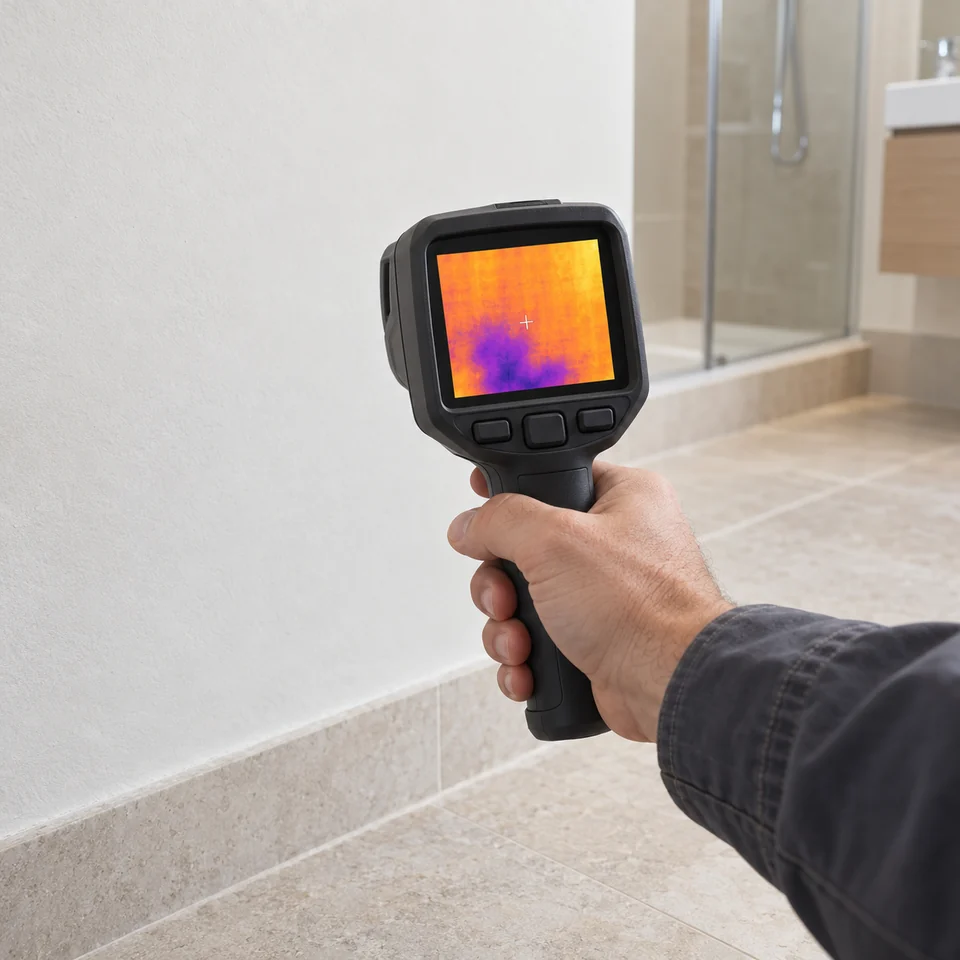
When investigating hidden water leaks, a thermal imaging camera can help a technician identify surface temperature differences and areas that need closer investigation. It cannot see through the wall: the thermal image provides information that must be interpreted in the context of the actual conditions.
A temperature difference does not automatically prove that water is present, nor does it always pinpoint a leak. Conditions in the room and the materials involved affect the findings. FM Impianti uses thermal imaging to support leak investigations, assessing which checks are appropriate for each case.
Separate investigation, repair and redecoration
Before agreeing to work, clarify what is being proposed: investigating the source, repairing a confirmed leak or making good the plasterwork and repainting. These stages need to be coordinated and may involve different skills and trades.
Before finishes are restored, the cause of the damp needs to have been addressed and the surface must be in a suitable condition. The timing and approach need to be assessed at the property; they cannot be determined from a single photo. Whether the wall needs to be opened depends on the checks required, so it is not possible to promise in advance that this will always be avoided.
Prepare for a clear discussion
If you suspect a water leak, contact FM Impianti with the location of the property, the room affected and what you have observed. Mention any previous work and arrangements needed to access the property: these details help us understand your enquiry.
The discussion helps establish how to proceed and what still needs checking before you plan the redecoration. A careful approach starts with distinguishing what is already known from what requires further investigation.